
By Miles Pearson · 27 October 2026 · 8 min read
IT consulting & strategy helps you decide where to invest in technology, what to change first and who will deliver it. AI strategy consulting applies those decisions to specific workflows, tests whether your systems and people are ready, and sets limits on how the tools will be used. When your team is stretched and every department wants a different AI tool, start with the work that needs improving.
An IT strategy addresses data, integration, security and ownership across the business. An AI strategy identifies the use cases those foundations can support and the evidence needed before wider deployment.
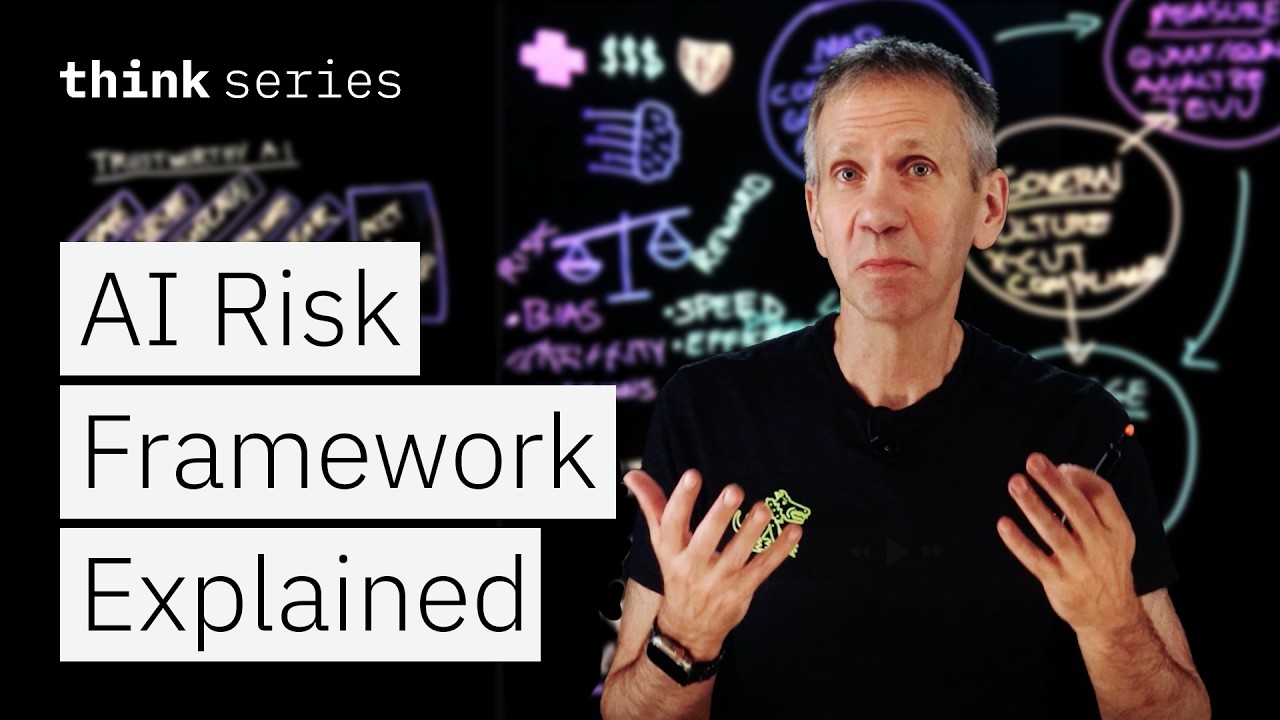 Watch on YouTube: Mastering AI Risk: NIST’s Risk Management Framework Explained (IBM Technology)
What IT consulting & strategy actually means
IT consulting can cover systems, architecture, cybersecurity, migration, implementation or daily technical operations. IT strategy consulting focuses on the decisions behind that work. It connects business objectives to the systems you need, the investments you can make and the measures that will show whether they worked. Cloud migration, data analytics and digital transformation all need a business reason.
For a growing business, a useful strategy can answer:
Which systems and processes are slowing delivery or creating risk?
What should be fixed, replaced, connected or left alone?
What can the team deliver with its current budget and capacity?
Who owns each decision, and how will leadership recognise progress?
An IT strategy and consulting engagement should help executives choose between competing priorities. A software shopping list will not do that. The internal technology team understands daily operations and usually owns longer-term system decisions. A consultant helps the team assess options and explain the trade-offs to leadership.
Strategy, implementation and IT support are different jobs
Work | Core question | Practical output |
|---|---|---|
IT strategy consulting | What should technology enable, in what order, and why? | Current-state assessment, investment priorities, roadmap, decision rights |
IT implementation consulting | How do we deliver a defined change? | Configuration, integration, migration, testing and handover |
Managed IT or support | How do we keep existing services working? | Monitoring, maintenance and resolved incidents |
AI strategy consulting | Which AI use cases are worth pursuing, and under what conditions? | Opportunity shortlist, readiness gaps, pilot design and success measures |
A business may need all four. Support staff keep systems running; they cannot decide for leadership whether a process needs redesign. A strategy also needs people who can integrate systems and maintain the resulting workflow.
What IT strategy consulting services should include
Scope varies by business. Ask what decisions the engagement will support and what the team will receive at handoff.
A current-state assessment
Start with the operations leadership wants to improve. Map the systems and their data, team handoffs, recurring manual work and known failure points. Include security, access controls, vendors, contracts and the people available to make changes. Sales and operations may blame an integration when neither team has agreed who owns customer records.
The output should distinguish facts from assumptions. If the team cannot tell how often a task is repeated, measure a baseline before promising savings.
A sequenced, funded roadmap
For each initiative, the roadmap should name an outcome, a change, a dependency, an owner and a way to measure progress. Put enabling work ahead of projects that depend on it. If customer records are inconsistent, agree on the data rules before automating follow-up messages. Show which changes can run in parallel.
Budget and team capacity constrain the sequence. A technically feasible project may still be a poor first move if it ties up the only person who understands the order system during a busy trading period.
Governance and delivery handoff
Name the people who can approve tools, data access, vendor contracts and changes to live processes. Set an escalation route for exceptions and incidents. Give delivery teams acceptance criteria and someone with authority to sign off the result. Executives may approve a roadmap that operations and IT still cannot execute if those details are missing.
For AI initiatives, the NIST AI Risk Management Framework is a useful reference for making risk management an ongoing responsibility rather than a one-off sign-off. A consulting firm can help define the controls, but the business must retain an owner who can make decisions when a workflow changes.
Track outcomes, not just project completion. A new integration being live is an activity. Fewer missed handoffs or faster order processing is the business result.
What the business gains from a good IT strategy
Clear priorities improve resource allocation. Teams can stop spending scarce capacity on overlapping projects, and executives can see which investment supports each outcome. Better integration can reduce duplicate entry and give service teams more reliable information for customer experience decisions. Security and continuity planning help teams prepare for disruption to a fragile process.
These benefits need to be measured against the business’s starting point. For an operations team, track manual handling time and corrections; for a service team, track delays and avoidable rework; for a technology team, track incidents or the cost of maintaining duplicate systems. A cloud migration may be necessary, but calling it successful solely because the move is complete says little about business performance or long-term cost.
Where AI strategy consulting fits into the IT plan
In McKinsey’s 2025 survey, many respondents said they used AI, while fewer reported a financial effect across their organisation:
"39% of respondents attributed any enterprise-level EBIT impact to AI." - McKinsey, The state of AI in 2025
AI strategy consulting starts with costly, repetitive or quality-sensitive tasks. Which ones can improve without exposing private data, creating too many errors or making operations dependent on a tool the team cannot manage? Predictable inputs and outcomes often call for ordinary rules-based automation.
An AI readiness assessment should examine data quality and permissions, the workflow owner, exception paths, required human judgement and the way the result will reach the systems people already use. IT strategy supplies the integration, identity, security and architecture context. AI strategy supplies use-case selection, human oversight, adoption planning and evidence that the change is worthwhile.
Decision | IT strategy contribution | AI strategy contribution |
|---|---|---|
Customer information is scattered | Set data ownership, access and integration priorities | Decide whether a proposed AI use case has reliable inputs |
Staff copy information between systems | Assess systems and integration constraints | Compare rules-based automation with AI assistance for variable tasks |
Leaders want to deploy an AI assistant | Set vendor, identity and data-handling requirements | Define approved uses, review points, pilot cohort and outcome measures |
Pilot performance is inconsistent | Diagnose data flows, uptime and system dependencies | Review task fit, output quality, training and escalation rules |
Put AI work on the same technology plan as other investments. Small experiments can proceed before a full systems overhaul, provided the team limits them to data and controls it can manage.
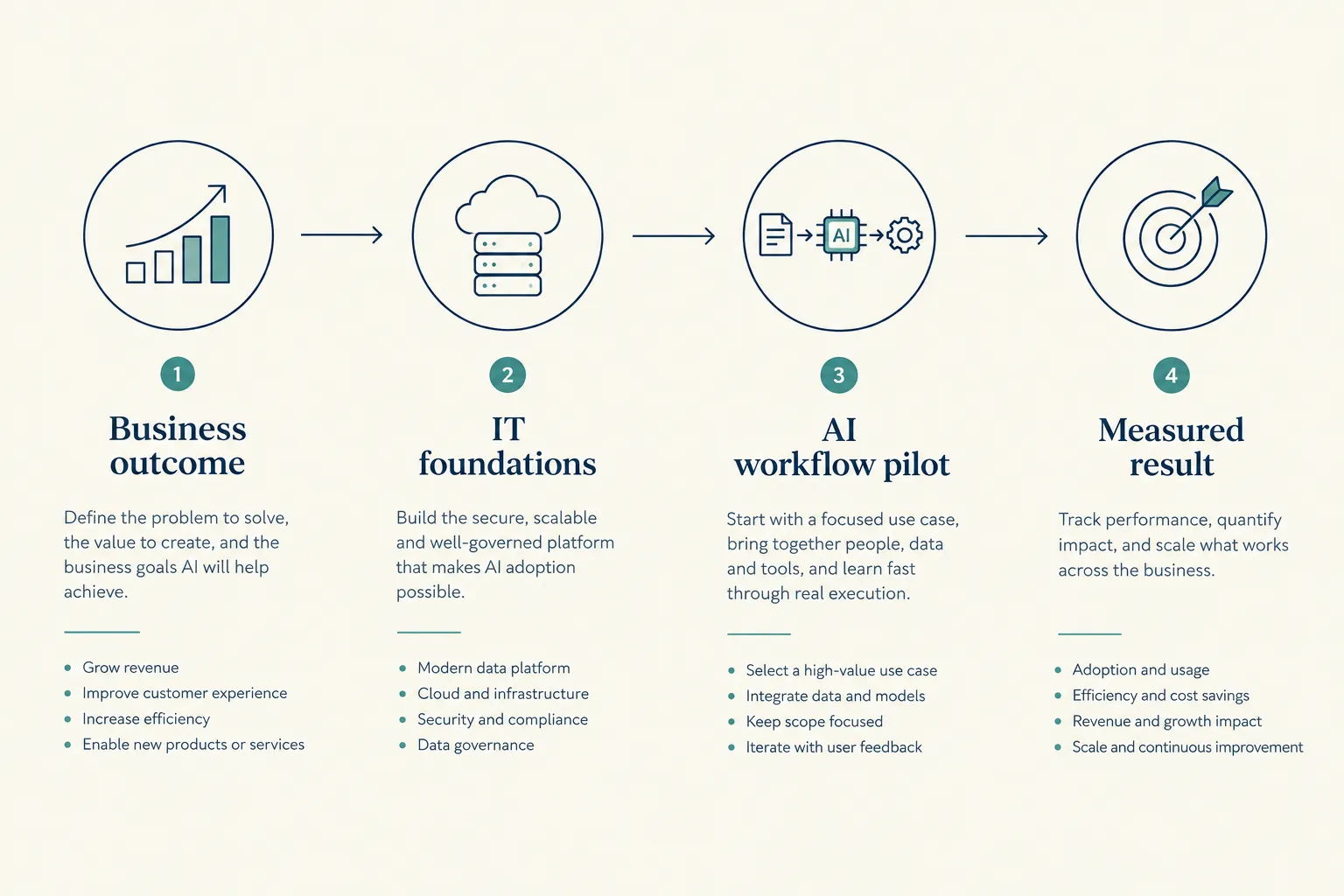
Turn a workflow problem into a measurable AI roadmap
Imagine a growing services company where operations staff rekey emailed client requests into a job system. They want to cut preparation time while keeping incorrect entries and response delays under control.
Map the work. Record where requests arrive, what information must be captured, who checks it, how exceptions are resolved and how the job system accepts updates.
Establish a baseline. Sample the current handling time, correction rate and number of requests needing manual follow-up. Use the same definitions after the change.
Compare interventions. Standard forms or a simple integration might remove the rekeying. If requests arrive in varied unstructured formats, an AI-assisted draft for staff review may be worth a limited pilot.
Set boundaries. Restrict the data available to the tool, specify who can approve a record, retain a route for ambiguous requests and define what happens when a draft is wrong.
Pilot and decide. Give an owner responsibility for tracking handling time, corrections and user feedback. Expand only if the improvement survives review and the support burden is manageable.
That plan gives the team a business outcome, prerequisites, a limited first release, an owner and a point at which to decide whether to continue. Hours saved free capacity for other work; they do not automatically reduce spending. Extra corrections could wipe out the gain.
Prioritise the work that can actually be delivered
Use a short decision sheet to compare workflows. Record how often each task occurs, how much time it takes and what errors cost. Then add data sensitivity, technical dependencies, the process owner and the effort of changing staff practice. Clear rules may point to basic automation; work that requires judgement may suit an AI drafting tool with a person approving the result.
Put prerequisites on the same sheet as the opportunity. If no one owns the underlying data, assign that ownership before committing to a model or vendor. Revisit the shortlist as the business changes.
When to bring in outside IT or AI strategy help
Outside advice can help when leaders cannot reconcile competing technology requests, operations are under strain or an AI proposal crosses several teams without an owner for the whole process. The business still has to own its decisions and the resulting workflow.
Ask a prospective adviser what the assessment delivers and how they choose priorities. Establish who will handle implementation and measure results. Will they recommend a simpler process change if AI adds little? Who will work with your executives, and who will stay involved when the team puts the plan into use?
Pearson Consulting Group works with CEOs, founders and executive teams on AI strategy and workflow automation. Its AI strategy service covers strategic context, opportunity assessment, phased roadmap design and practical recommendations. Its automation work includes process mapping, design and build, integration and testing, and handover documentation. That makes it a fit when the immediate challenge is choosing and implementing a practical AI or automation opportunity; a business seeking a full outsourced IT operations provider will need different support.
Make the strategy earn its place
IT consulting & strategy should give leaders investment decisions their teams can carry out. AI strategy should show whether a particular workflow improves under controls the business can maintain. Both belong in an operating plan with owners and a starting measure for results.
If manual work is mounting and AI proposals are pulling your team in different directions, book a strategy call with Pearson Consulting Group. Miles Pearson works directly with leaders to choose a commercially relevant first move, map the workflow and carry the plan into implementation.
FAQ
What do IT consulting companies do?
They advise on technology decisions and may also help assess systems, design architecture, implement changes or support operations. IT strategy consulting specifically connects business goals to priorities, a roadmap and measures of success.
What should be in an IT strategy?
It should describe the current environment, the outcomes technology needs to support, prioritised initiatives, dependencies, budget and capacity assumptions, accountable owners, risks and success measures. Include data, security and governance so teams can deliver the plan safely.
What does "consulting and strategy" mean?
Consulting is the advisory work used to assess a situation and recommend or support change. Strategy is the set of decisions about goals, priorities, trade-offs and sequence; in IT, those decisions connect technology investment to business results.